HR Transformation Is Not a Technology Project. So Why Do We Still Treat It Like One?
- 6 Min Read
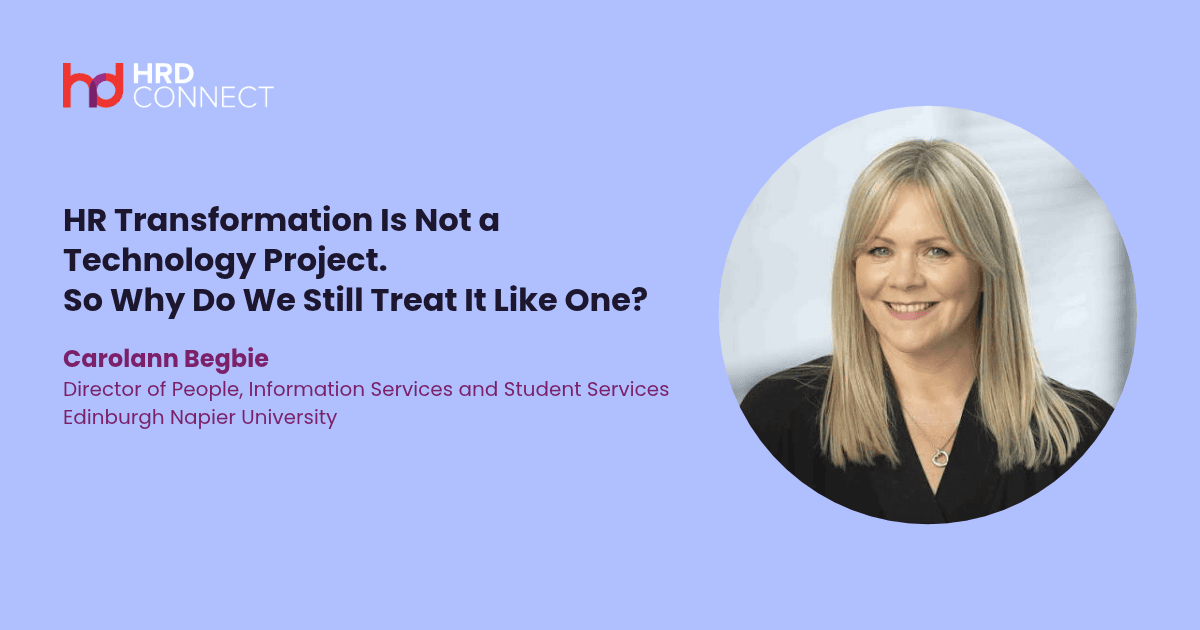
Speaking to HRD Connect at MHR’s World of Work 2026 (WOW26), Carolann Begbie, Director of People, Information Services and Student Services at Edinburgh Napier University, explains why successful HR transformation starts with changing how people work, not installing new technology.
- Author: Carolann Begbie
- Company: Edinburgh Napier University
- Date published: Oct 15, 2026
- Categories
A new HR platform will not transform an organisation if everything around it stays the same.
That is the principle guiding Edinburgh Napier University as it modernises its people processes with MHR. For Carolann Begbie, Director of People, IS and Student Services, the opportunity is to rethink who does what, remove unnecessary administration and give the people function more space to focus on strategy.
“I fundamentally believe in seeing it as a change programme rather than as a technology implementation,” Begbie told HRD Connect at MHR’s World of Work 2026.
Her current remit brings people and technology and student services under the same leadership, giving her a direct view of how closely the three need to work together.
‘Adopt, not adapt’
At Edinburgh Napier, the introduction of People First is not about transferring work to managers and employees; it is about making routine HR processes simpler, and more accessible through improved self-service functionality.
The university has historically relied on spreadsheets and manual processes. Rather than simply recreating those processes in a new system, it is taking what Begbie describes as an “adopt, not adapt” approach as it prepares to go live with People First.
Instead of heavily customising technology around established ways of working, employees are being asked to adopt more standardised processes. Customisation is challenged by default and they will only adapt if there is a clear strategic, regulatory or operational need.
That has created some resistance, particularly around whether the same expectations can apply across academic and professional services populations.
‘There is often concern about whether the same processes can work across different groups but we have found with the right support and design, many activities can be successfully managed through self service.
For Begbie, this is where organisations need to challenge the instinct to preserve existing practices simply because “this is how we’ve always done it”.
“I understand that people don’t like to have to change,” she said.
But accommodating every historic process risks carrying the same complexity into a newer system. The aim is not to transfer work unnecessarily, but to simplify routine processes, provide managers with easier access to information and insights about their teams and to allow People team colleagues to focus on higher value support, workforce planning and organisational development.
Freeing HR from firefighting
Greater self-service should also change what Edinburgh Napier’s people team spends its time doing.
During her five years at the university, Begbie has sought to strengthen the People team by moving from being a “transactional, operational, reactive, people service” towards a more strategic function.
Fewer routine administrative requests should create more capacity to focus on culture, behaviours, talent, succession and organisational capability.
That is particularly important as Edinburgh Napier refreshes its wider strategy. Begbie wants the People team involved earlier in conversations about what it will take to deliver the organisation’s ambitions.
“An important question I ask as we get ready to launch our new strategy is, do we have the capability internally to deliver it?”
Rather than waiting until a capability gap becomes a recruitment problem, the People team can ask what skills the organisation will need, which already exist internally and where development or recruitment will be required.
For Begbie, having the right systems in place provides a foundation for the People team to spend more time answering those questions.
What financial services taught Begbie about HR
Begbie’s approach is also shaped by a career spanning Scottish financial services, including roles at AEGON, Standard Life, Sainsbury’s Bank and Tesco Bank.
Her move into higher education followed involvement in a major culture transformation programme at Tesco Bank and marked her first People Director role.
The transition brought some surprises.
Begbie found expectations of the HR function within higher education more traditional than those she had experienced in financial services.
But that also presented an opportunity to reposition the function.
She had also deliberately sought a sector where she could feel a stronger connection to organisational purpose. At a university, the impact of that purpose is visible through the students it serves.
That connection has become particularly important at Edinburgh Napier, where Begbie’s responsibilities span employees, technology and student services.
What can HR learn from the students it serves?
Universities occupy an unusual position in the skills debate. They are employers managing their own workforce challenges while simultaneously preparing people for the future labour market.
Begbie’s remit includes employability and careers, giving her visibility into both sides.
She believes employers should look beyond traditional measures such as requiring graduates to achieve a 2:1 and pay closer attention to the capabilities candidates actually bring.
“I think focusing on the skills that somebody’s going to bring to a role is just as important,” she said.
Edinburgh Napier is embedding employability into its curriculum, considering both the technical knowledge students need and the wider skills required to enter the workplace.
There is a useful feedback loop for the People team. If the university is identifying the capabilities graduates will need to succeed with employers, it also needs to consider whether it is developing those capabilities within its own workforce.
Its proximity to students can also challenge assumptions about younger workers.
Begbie recalled two young people completing work experience through Career Ready who said they wanted to come into the office and meet colleagues. That challenged the assumption that younger generations will automatically prefer remote working.
For employers managing multigenerational workforces, the lesson is straightforward: generational labels cannot replace actually asking people what they value from work.
HR needs the foundations to think further ahead
Edinburgh Napier’s experience points to a wider opportunity for HR.
Reducing administration is valuable, but what matters is what the function does with the capacity it creates.
For Begbie, that means moving further upstream: contributing to business planning, understanding future capability needs, shaping culture and thinking about the skills an organisation will require before shortages emerge.
It also means managers and employees taking greater ownership of everyday people processes rather than treating the People team as the default destination for every problem.
The bigger measure of Edinburgh Napier’s project will therefore not be whether employees use a new platform.
It will be whether the people function has more time and better information to help the university answer a much more strategic question: do we have the people and capabilities we need for where the organisation is going next?