MHR WOW26: What the Opening Keynotes Tell Us About the Future of Work
- 6 Min Read
The opening keynotes at MHR World of Work 2026 (WOW26) challenged HR leaders to rethink AI, skills and workplace efficiency. Here are the key insights from MHR CEO Anton Roe and Ogilvy UK’s Rory Sutherland.
- Author: HRD Connect
- Date published: Sep 25, 2026
- Categories
AI might be changing the mechanics of work, but should HR be equally concerned about what gets lost in the pursuit of efficiency?
That tension ran through MHR’s World of Work 2026 (WOW26), which brought HR, finance, payroll and business leaders together at London’s Tobacco Dock to discuss how AI, behavioural science, skills and leadership are reshaping organisations.
Across the day, the message was not that HR should resist technology. It was that organisations need to think much harder about how technology changes work itself.
For HR leaders, that distinction matters.
From jobs to skills
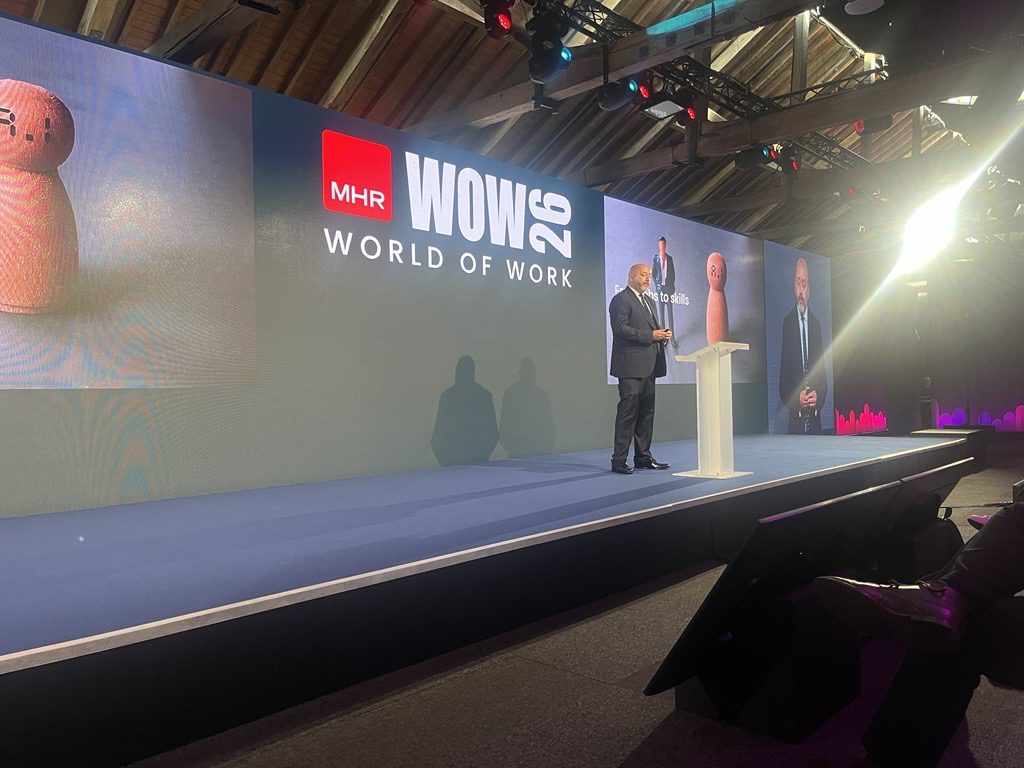
Opening the event, MHR CEO Anton Roe argued that organisations are already facing overlapping pressures: tighter budgets, changing workforce expectations, skills shortages, new technology and demands to make decisions faster.
AI adds another layer.
As automation takes on individual tasks, Roe argued that organisations may increasingly need to move from asking “What jobs do we need?” to “What skills do we need?”
It is a significant shift for HR. Jobs have traditionally provided the architecture around which recruitment, pay, development and progression are organised. But if AI changes the bundle of tasks sitting within those jobs, static job descriptions may become less useful for understanding organisational capability.
Roe’s argument was not that human contribution disappears. AI can process information, identify patterns and handle routine activity, he said, while people continue to provide judgement, creativity, empathy, experience and accountability.
Recent CIPD research points to a similar challenge. Its research into AI and the workforce argues that the immediate constraint around AI is often not access to technology, but organisations’ ability to apply capabilities such as workforce planning, job design and employee engagement as work changes.
For HR, AI adoption therefore cannot sit separately from workforce strategy.
MHR puts connected decisions at the centre
That thinking also underpins MHR’s own technology strategy.
At WOW26, Roe introduced updates to MHR’s People First platform, including People First Skills, designed to give organisations greater visibility over existing and future skills, and People First CoWork, which introduces a more conversational way of interacting with the platform. People First Finance also brings people, pay, time and financial information into a more connected environment.
The wider argument was that HR, payroll and finance decisions can no longer be treated as isolated conversations.
A recruitment decision affects workforce capacity and budgets. A change in working patterns influences employee experience, payroll and financial planning. A skills shortage can affect productivity and ultimately business strategy.
That puts HR in a potentially more influential position, but only if people leaders can connect workforce information to wider organisational decisions.
Are we redesigning work, or automating what already exists?
Rory Sutherland, Vice Chairman at Ogilvy UK, approached the future of work from a very different direction.
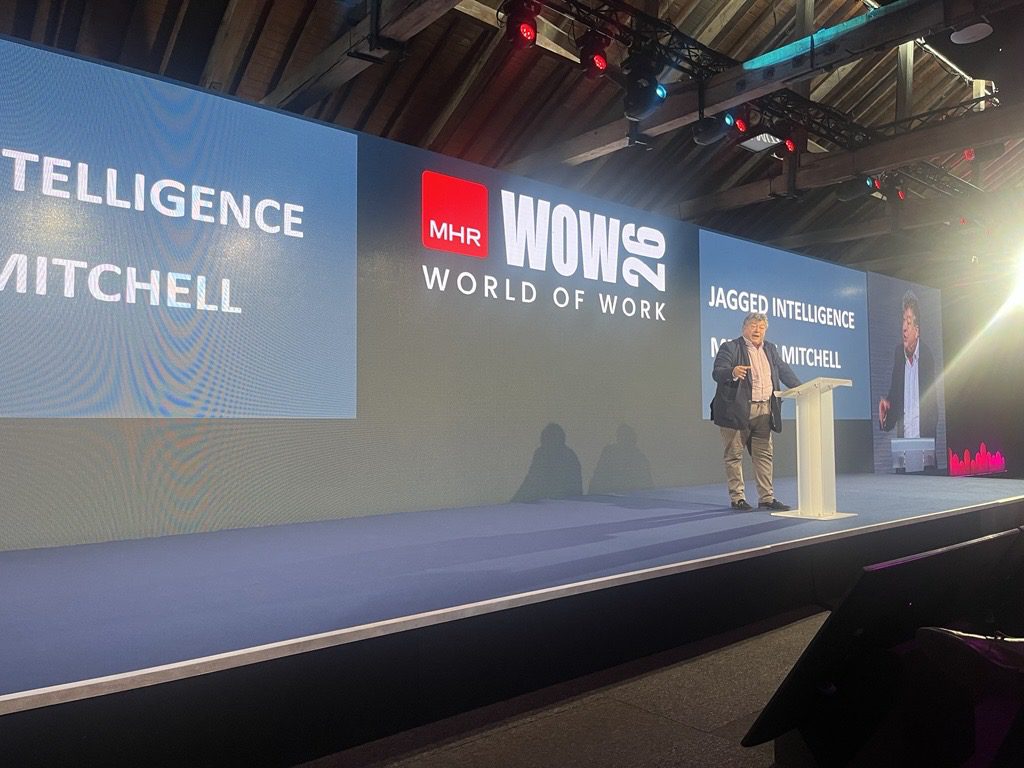
His warning was against becoming so focused on efficiency and optimisation that organisations overlook how people and businesses actually behave.
Sutherland used the history of factory electrification to illustrate the point. When electric motors first arrived, factories initially used the new technology as a direct substitute for steam engines. The larger productivity gains came later, when businesses redesigned factories around what electricity made possible.
His comparison with AI was clear: organisations risk using a transformative technology simply to perform existing processes more efficiently.
That poses an important question for HR.
If AI can automate part of a role, should the remaining role simply become smaller? Or should HR reconsider how the work is designed altogether?
Research from the CIPD has similarly highlighted the importance of connecting AI adoption with job design, skills development and workforce planning rather than treating AI training as a standalone intervention.
Efficiency can hide the value people create
Sutherland also challenged one of the assumptions behind automation: that a person’s value can be understood by looking at the formal tasks attached to their role.
He illustrated this through what he calls the “doorman fallacy”. If a hotel defines a doorman solely as someone who opens a door, replacing that person with an automatic door looks like an obvious efficiency gain.
But the employee may also greet regular guests, help with taxis, provide security, answer questions and contribute to the experience of entering the hotel.
Those less visible contributions can disappear from a spreadsheet precisely because they are difficult to measure.
It is a useful warning for HR teams assessing which tasks AI can replace.
Breaking jobs into tasks can reveal opportunities for automation, but it can also obscure the informal relationships, institutional knowledge and human judgement wrapped around those tasks.
HR may need to protect experimentation
Another theme from Sutherland’s keynote was the danger of over-optimisation.
He argued that organisations often design processes to produce consistent, defensible decisions. Recruitment is one example. Businesses define a vacancy, establish criteria and find the candidate who most closely matches them.
But that process can make it harder to hire someone simply because they possess an unusual combination of capabilities that could prove valuable.
His challenge to HR was essentially to leave room for the unexpected. Not every successful hire, innovation or career path can be designed in advance.
That becomes particularly relevant as AI makes it easier to standardise recruitment, performance and workforce decisions.
Consistency can reduce friction. It can also create homogeneity if every organisation uses similar technology, data and criteria to identify the same definition of an ideal employee.
The future of work is still a people question
Perhaps the strongest connection between Roe and Sutherland’s very different keynotes was their rejection of a simple people-versus-technology narrative.
Roe argued that the opportunity lies in people working alongside AI, with technology removing friction while humans contribute judgement and creativity.
Sutherland went further, suggesting that AI could become more valuable when used collectively rather than as an individual productivity tool. Instead of imagining the future as one employee interacting with one AI system, he encouraged organisations to consider AI as something that could enhance the intelligence of groups.
That leaves HR with a bigger challenge than implementing another technology.
People leaders need to understand which tasks AI can perform, which skills the organisation will need next and where human contribution is less visible but still valuable. They also need to question whether existing roles and processes still make sense once new technology arrives.
The message from WOW26 was ultimately less about predicting exactly what work will look like and more about deciding how organisations respond to change.
As Roe put it at the close of his keynote, the future of work will not be determined by technology alone.
For HR, the opportunity is to make sure that remains true.
Over the coming weeks, HRD Connect will be sharing more insights from MHR’s World of Work 2026, including exclusive interviews with HR and people leaders from the event. We’ll explore how organisations are approaching AI, skills, learning, HR transformation and the changing employee experience, and what their experiences can teach HR leaders preparing for what comes next.