From HR to the C-Suite: Why Tom Emery Believes Leadership Must Become More Human
- 6 Min Read
Tom Emery, performance coach, founder of HEX and author of People People, shares insights from his journey to the C-suite and explains why commercial influence, trust and human leadership are becoming increasingly important in an age of AI and organisational complexity.
- Author: HRD Connect
- Date published: Jun 9, 2026
- Categories
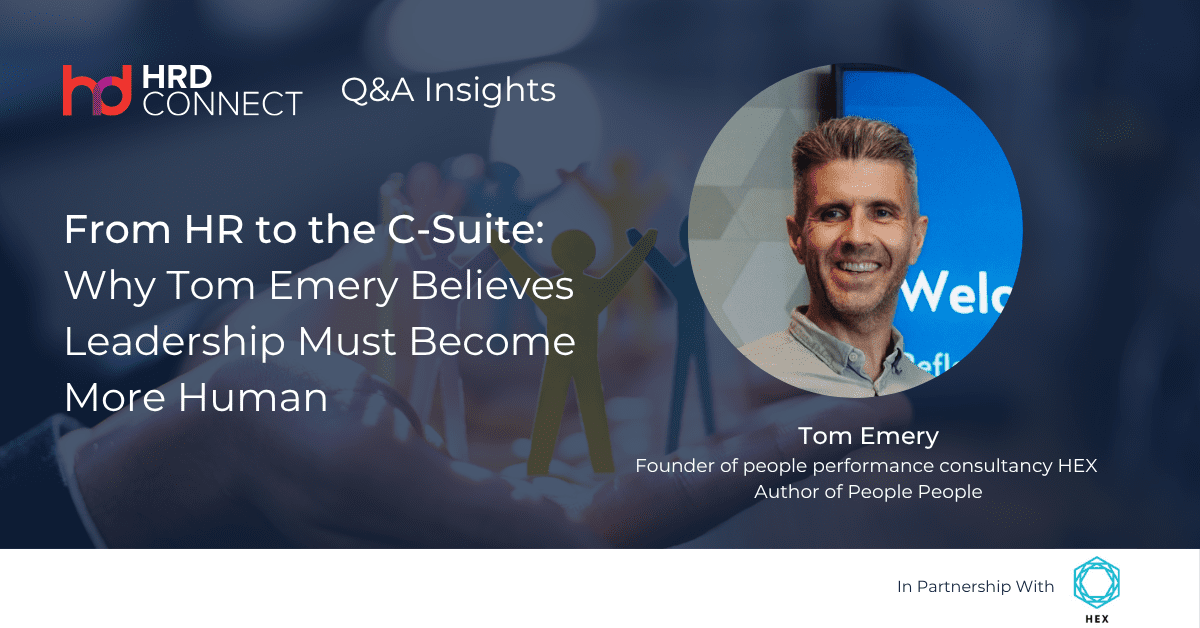
Tom Emery’s career has taken him from HR roles across retail, telecoms, local government, banking and wealth management to the executive table as a Chief People Officer. Today, he is a performance coach, founder of people performance consultancy HEX and author of People People: Reach your full potential as a Chief HR Officer: Reach your , working with senior leaders to strengthen clarity, resilience and performance.
In conversation with HRD Connect, Emery reflected on what his journey has taught him about HR’s strategic influence, the changing expectations of leaders and why the future of performance will depend as much on human connection as operational execution.
Emery’s experiences across different sectors and leadership environments eventually shaped what became his CHRO impact framework; a model built around the personas he found most critical in making the transition from HR leader to strategic C-suite influencer. The framework focuses on three personas: the Commercial Explorer, the Enterprise Leader and the Trusted Partner. Together, they show how HR leaders can move beyond functional expertise and become strategic contributors at the highest level.
HR influence starts with commercial understanding
Emery says he “fell into HR” partly by accident and partly because he “liked people.” But his early experience quickly showed him that HR was not just about supporting employees in ideal conditions. It was often about seeing “people sometimes in their worst situations” and learning how organisations behave under pressure.
That perspective was shaped by working across very different environments. Retail gave him a grounding in operational pressure and commercial discipline. “You’re working with very tight margins,” he said, describing the importance of understanding how day-to-day business really works.
This links closely to what Emery describes as the Commercial Explorer persona. HR leaders, he argues, need curiosity about how the organisation makes money, where risk sits, what customers need and how commercial priorities shape leadership decisions.
Moving from HR leader to enterprise leader
Emery describes his move into the C-suite as one of the biggest shifts in leadership identity.
“When you step into that C-suite role, you’re no longer the HR person, you’re no longer the finance person, you’re no longer the salesperson,” he said. “You’re turning up for that C-suite team.”
That shift reflects the Enterprise Leader persona. Instead of advocating only for the HR function, senior people leaders must think across the whole organisation and contribute to enterprise-wide priorities.
“We let go of a lot of the control and we have to turn it into influence,” Emery said. “That’s a big thing for a lot of people.”
The trusted partner is not always the agreeable one
A recurring theme in Emery’s work is the distinction between being helpful and being truly trusted.
“Often we mix up being a trusted partner with being a supportive partner,” he said. “Sometimes it might be quite uncomfortable that you have to say no to what they want in service of giving them what they need.”
This is the Trusted Partner persona in action. For Emery, trust is not built by agreeing with leaders or simply delivering what they ask for. It is built by offering honest challenge, holding up the mirror and identifying where decisions, behaviours or cultural patterns may be undermining performance.
He also sees HR as a key connector at senior level, describing the role as “the glue that keeps your C-suite together.”
Leadership is becoming more emotionally demanding
Through his coaching work at HEX, Emery sees senior leaders carrying a heavier emotional load than ever before. They are expected to deliver performance, manage uncertainty, support wellbeing, lead change and maintain trust across increasingly complex organisations.
This has changed the definition of effective leadership. High performance can no longer mean constant output or permanent availability. Without recovery, boundaries and emotional regulation, sustained pressure quickly turns into burnout.
“People do not like senior leaders who are erratic and who find it difficult to manage emotions,” Emery said.
Psychological safety does not mean lower standards
A key theme in Emery’s work is psychological safety. But he is clear that this should not be confused with avoiding accountability.
Psychological safety means creating conditions where people can challenge constructively, raise concerns and contribute honestly without fear. In complex environments, that openness is essential to better decision-making and stronger performance.
For HR leaders, the task is to help managers build trust while still maintaining clear expectations.
AI raises the value of human leadership
As AI becomes embedded in HR workflows and wider business operations, Emery believes leaders have a choice to make.
“If you’re not curious about AI and you’re not curious about what it can bring and what it can do and how it can help you, then I think you’re going to get left behind,” he said.
But he is equally clear that AI adoption must be handled as a human transition, not just a technical one. Employees need leaders who can listen to concerns, create clarity and build confidence through change.
“You listen to what people are worried about, you sit with them in that, you don’t necessarily try and solve every anxiety,” he said. “You create an optimistic view of the future.”
For Emery, the central question for HR is how to “make tech human.” AI may improve process efficiency, but if it removes human connection from moments that require judgement and empathy, it risks damaging trust.
Future HR leaders need adaptability and strategic confidence
Looking ahead, Emery believes adaptability will be one of the defining capabilities for HR and business leaders. The profession is being asked to operate across regulation, AI, wellbeing, workforce planning, culture and performance at once.
His advice to HR leaders is direct: “Keep looking up, keep looking out, keep asking questions, keep challenging the organisation on whether it’s going in the right direction.”
He also cautions against waiting for permission to become more influential. “There’s always choice that we’ve got,” he said. “You can be much more impactful just by making some small changes.”
A more human model of performance
Emery’s journey from HR practitioner to C-suite leader and performance coach points to a broader shift in leadership. Organisations are moving beyond narrow definitions of performance based purely on output, efficiency and control.
His CHRO impact framework captures that shift. The future people leader must be a Commercial Explorer, an Enterprise Leader and a Trusted Partner, moving between commercial curiosity, organisational leadership and courageous challenge.
In an age of AI, volatility and workforce pressure, sustainable performance will depend on leaders who can create clarity, trust and connection. For HR, the opportunity is to shape that leadership agenda rather than simply respond to it.
The future of high performance is not less human. It is more human, more intentional and more closely connected to how people experience work every day.