
Learning to Lead: The Role of Lifelong Learning in Shaping Effective Directors
- 5 Min Read
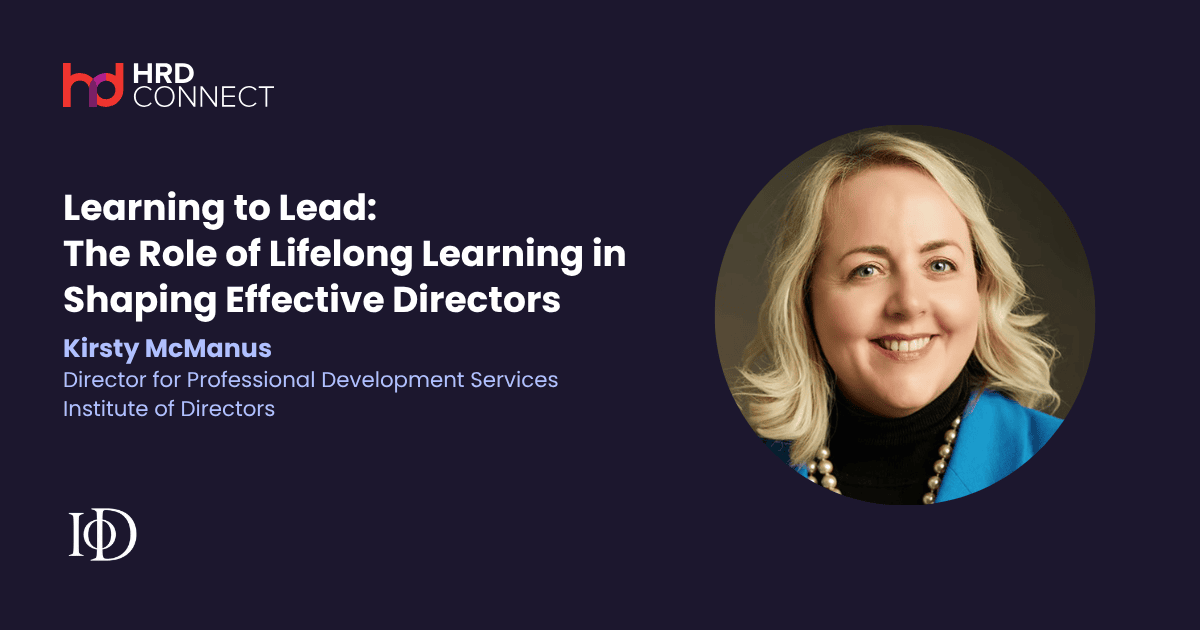
Kirsty McManus, Director for Professional Development Services at the Institute of Directors, explains why continually evolving responsibilities means that today’s most effective directors can’t just be experienced leaders, they need to be active lifelong learners too.
- Author: Kirsty McManus
- Company: The Institute of Directors
- Date published: Aug 25, 2026
- Categories
Across all sectors, the pace of evolution in the roles and responsibilities of company directors shows no sign of slowing. This is due to a uniquely challenging combination of internal and external factors.
Regulatory frameworks for data privacy, environmental impact and AI ethics are evolving rapidly worldwide, while shifting global trade policies and conflicts require constant geopolitical literacy. Meanwhile, environmental, social and governance (ESG) standards require deep, updated climate and societal knowledge. Workforce evolution presents a further challenge, with issues such as remote work, gig economies and shifting employee expectations demanding new strategies around human capital.
All of these factors are driving constant change in the areas directors need to operate across, including the nature of the decisions they need to make and the speed at which they need to make them.
This is especially true given the speed of business disruption now outpaces the traditional tenure of a director, meaning boards can no longer rely solely on past experience or individual expertise to shape future strategies.
It goes without saying that ‘traditional’ areas of knowledge, such as governance, finance and industry expertise remain central to a director’s role. However, these alone are no longer sufficient. Digital understanding, risk awareness, emotional intelligence also all need to be part of the modern director’s armoury.
This shift has redefined what effective leadership means, while underscoring a key principle: director development shouldn’t end once a person joins the board. Few directors will be competent in all of these areas on the day they first sit at the boardroom table, and even for those that are, the goalposts are constantly shifting. This makes lifelong learning a critical component of any board strategy.
The significance of lifelong learning
Lifelong learning is a continued commitment to gaining new skills and perspectives, rather than a piecemeal or reactive approach.
This helps directors to develop a broad perspective, as well as the confidence and adaptability necessary to reach and implement informed decisions in ever-more complicated business environments. Continuous learning in this way also allows directors to ask executive teams sharp, informed questions while avoiding ‘groupthink’.
The value of lifelong learning is particularly key when it comes to the role of technology, and in particular AI, which is increasingly prevalent across almost every business area. For directors, developing an effective understanding of AI’s capabilities – alongside its limits, risks and potential problems – will be critical in ensuring informed decisions, around areas such as ethics and governance, can be made.
Meanwhile, constant changes in the wider world brings new challenges almost daily. Regulatory frameworks evolve relentlessly, while cyber threats and reputational risks can never be ignored. Each of these requires a willingness among every director to rapidly understand new issues at a strategic level and respond in an agile manner. Board members must also understand emerging market trends to guide long-term corporate resilience.
Another area where lifelong learning can drive true improvement is in organisational culture and leading people. Recent years have seen emotional intelligence evolve from being a desirable ‘soft skill’, to a mandatory leadership capability, every bit as crucial as technical expertise.
Leaders who take the time to understand colleagues build stronger cultures, where individuals feel heard, valued and able to contribute. They are also better equipped to understand customers, engage stakeholders and handle uncertainty or change constructively.
To gain the necessary understanding in all these areas – and the skills needed to respond effectively – every director must adopt a proactive approach to learning. There are multiple sources, from formal education to executive programmes, through to the use of specialist advisors and mentoring, that can help to achieve this. Meanwhile, directors should never forget that their own board colleagues will all hold stores of knowledge they can tap into.
Impact beyond the boardroom
The advantages of lifelong learning at board level extend beyond individual directors too. A culture where directors actively pursue learning will also reinforce leadership pipelines across the organisation. Future executives will observe daily how qualities such as curiosity, adaptability and personal development – and the acquisition of skills which foster these attributes – are valued at each stage of their career.
A perception of learning as an integral and continuous component of organisational culture, rather than a reactive or sporadic element, will substantially contribute to organisational resilience.
Looking ahead
Boards that prioritise continuous development will inevitably be better equipped to discern emerging opportunities, anticipate risks and make well-informed decisions that balance immediate operational demands with longer-term strategic objectives. They are also more adept at attracting diverse talent whose expertise mirrors the inherently multidisciplinary nature of contemporary leadership.
Looking ahead, board-led governance is likely to undergo further evolution. For example, leadership programmes now exist which marry oversight of ongoing performance with areas such as innovation, transformation and future expansion.
However, irrespective of how governance models evolve in the years to come, one principle will remain unaltered: the directors who generate the greatest value may not be those with the most extensive experience, but rather those most inclined towards – and supported in – lifelong learning. In an era where constant change prevails, lifelong learning transcends being a mere individual pledge to become a strategic asset for both directors and the organisations they lead.