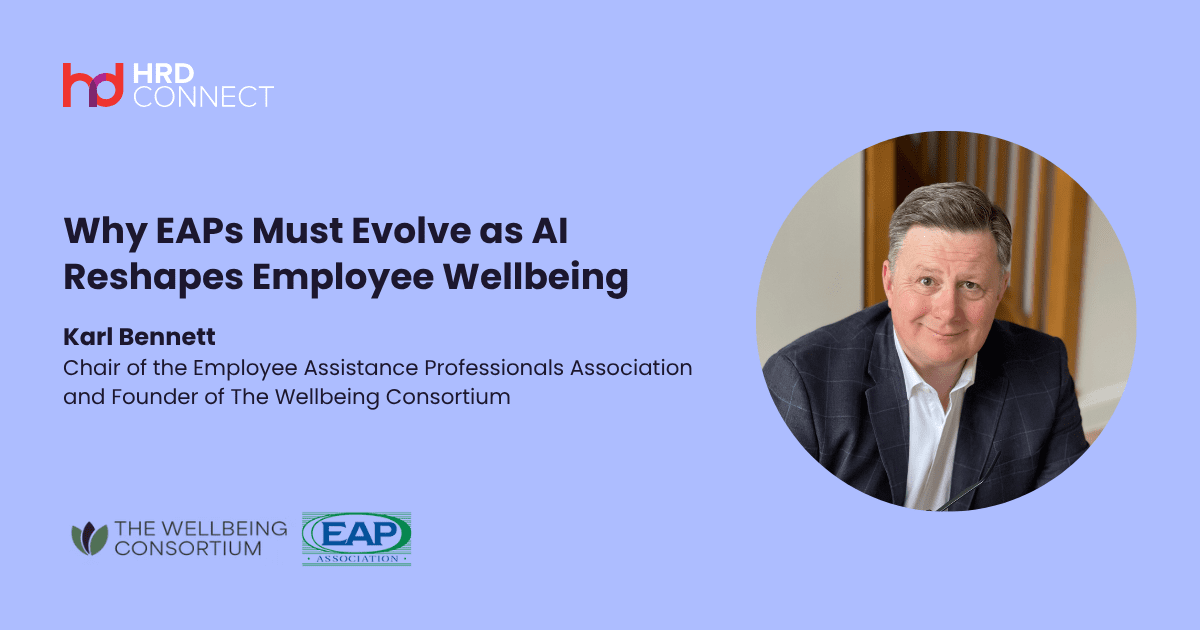
Why EAPs Must Evolve as AI Reshapes Employee Wellbeing
- 7 Min Read
As AI becomes increasingly embedded in the workplace, organisations are grappling with new wellbeing challenges ranging from job insecurity and workforce anxiety to the growing use of chatbots for emotional support. Karl Bennett, Chair of EAPA UK and founder of The Wellbeing Consortium, explains why Employee Assistance Programmes (EAPs) must evolve, how co-therapy models could shape the future of support, and why human connection remains essential to effective workplace wellbeing.
- Author: HRD Connect
- Date published: Jun 18, 2026
- Categories
Artificial intelligence is rapidly changing how employees work, learn and access support. While much of the conversation has focused on productivity and automation, a growing debate is emerging around AI’s impact on employee wellbeing.
Employees are increasingly interacting with AI tools throughout the working day, while some are also turning to chatbots and generative AI platforms for advice, emotional reassurance and mental health support. At the same time, concerns about job security, workforce transformation and the pace of technological change are creating new sources of stress and uncertainty.
For Karl Bennett, Chair of the Employee Assistance Professionals Association (EAPA UK) and founder of The Wellbeing Consortium, these developments represent one of the most significant shifts the wellbeing profession has faced in decades.
Drawing on more than 30 years of experience in employee wellbeing and Employee Assistance Programmes (EAPs), confidential services that provide employees with access to counselling, mental health support and practical guidance, Karl believes AI has the potential to improve access to support. However, organisations must be careful not to confuse accessibility with effective care.
His perspective comes at a time when wellbeing is increasingly being viewed as a performance issue rather than simply a workplace benefit.
Recent findings from Deloitte’s 2025 Global Human Capital Trends report found that organisations are placing greater emphasis on human sustainability, recognising that employee wellbeing, adaptability and resilience are becoming critical drivers of long-term business performance. Similarly, Microsoft’s 2025 Work Trend Index highlighted growing concerns around employee overload, cognitive strain and the challenge of navigating increasingly complex digital workplaces.
Against this backdrop, the role AI will play in supporting employee wellbeing has become an important question for organisations across every sector.
AI is already part of the wellbeing conversation
According to Karl, many organisations are approaching AI wellbeing tools as though they are still emerging technologies. In reality, employees are already using them.
Whether through ChatGPT, digital assistants or AI-powered search tools, employees have become accustomed to seeking information and advice from technology. It is therefore unsurprising that some individuals are also beginning to use these tools when they are feeling anxious, uncertain or emotionally vulnerable.
This creates both opportunities and risks.
“I worry about organisations jumping on a bandwagon when it comes to wellbeing services,” Karl explains.
Rather than focusing on the technology itself, he believes organisations should first establish what problem they are trying to solve.
“What we’ve got to be careful of is that organisations that are introducing it understand what it is that they want to achieve.”
The observation reflects a broader challenge facing workplace wellbeing. New technologies often arrive before clear frameworks exist to define how they should be used, measured or governed.
The industry is still defining AI’s role in wellbeing
Karl believes the wellbeing sector is still in the early stages of understanding where AI can add the greatest value.
“Has AI reached its zenith yet? Do we know where its best place is within wellbeing, certainly within the world of EAPs?” he asks.
While AI has demonstrated potential across a range of applications, questions remain about where responsibility should sit and where human intervention becomes essential.
“Should AI be being used as a triage service? Should it be being used as a clinical tool? Should it be used in psychoeducation or signposting or guiding? I don’t think people know exactly where it’s going to fit right now.”
This uncertainty is reflected in wider research. The 2025 TELUS Mental Health Index found that employees are increasingly open to using digital tools to support their wellbeing, but continue to place significantly higher levels of trust in qualified human professionals when dealing with complex mental health concerns.
The findings suggest that while technology can improve accessibility, trust remains rooted in human expertise.
The psychological impact of AI is often overlooked
While AI’s impact on productivity receives significant attention, Karl believes organisations should devote more attention to its psychological effects.
Employees are being asked to adapt to new technologies at unprecedented speed. Some may worry about the future relevance of their skills. Others may feel pressure to continuously learn and evolve as roles change around them.
This creates a new category of wellbeing challenge.
As organisations accelerate AI adoption, concerns around uncertainty, confidence and workforce identity are becoming increasingly common. These issues may not always appear in traditional wellbeing reporting, but they can have a direct impact on engagement, performance and resilience.
The World Economic Forum’s Future of Jobs Report 2025 identified technological change as one of the most significant forces reshaping work over the next decade, with employers expecting substantial shifts in job design and skills requirements. The report also highlighted resilience, adaptability and lifelong learning as some of the most important workforce capabilities for the future.
For many employees, developing those capabilities will require support as well as training.
Co-therapy may become the future of EAP provision
Despite his caution, Karl is optimistic about the role AI could play within wellbeing services when applied appropriately.
One of the most promising developments, he believes, is the emergence of co-therapy models, where AI complements rather than replaces human practitioners.
Under this approach, AI may support activities such as psychoeducation, reflection exercises, signposting and engagement between counselling sessions. Human counsellors would continue to provide therapeutic expertise, clinical judgement and emotional support.
The model offers the potential to increase accessibility while preserving professional oversight.
Importantly, Karl does not see AI as a substitute for therapists.
The future, he suggests, lies in creating better pathways into support rather than replacing support altogether. This distinction becomes particularly important given growing concerns about individuals using AI chatbots as substitutes for professional mental health care.
Human connection remains the benchmark
Perhaps Karl’s strongest message is that workplace wellbeing cannot become purely transactional.
While AI may provide convenience, immediacy and scale, effective wellbeing support ultimately depends on trust, empathy and human understanding.
Technology can help employees take the first step towards support. It can reduce barriers, improve accessibility and provide useful information. However, when employees face complex emotional challenges, safeguarding concerns or significant mental health issues, qualified professionals remain essential.
The organisations likely to achieve the greatest success will be those that use AI to strengthen human support rather than replace it.
Wellbeing must be measured with purpose
Beyond technology itself, Karl also highlighted the growing importance of meaningful wellbeing measurement.
Too often, organisations implement wellbeing initiatives without clearly defining what success looks like.
“You only know how good your wellbeing is going if you know what it is that you’re trying to change or what impact you’re trying to have,” he says.
For Karl, data should support decision-making rather than exist for its own sake.
“If you’re trying to introduce a product that improves absenteeism when you don’t have a problem with absenteeism, then what do you hope that data is going to show you?”
As wellbeing becomes increasingly connected to organisational performance, measurement is becoming a strategic capability. The most effective organisations are likely to be those that align wellbeing interventions with specific workforce challenges and business outcomes.
Building a more intentional wellbeing strategy
AI will undoubtedly continue to influence the future of employee wellbeing, EAP provision and workplace mental health support. The opportunity to improve accessibility, personalise support and identify emerging employee needs is significant.
However, Karl’s perspective is clear: successful adoption will depend on intentionality rather than enthusiasm.
Technology should solve a defined problem, operate within clear governance frameworks and support measurable outcomes. Most importantly, it should enhance rather than diminish the human relationships that underpin effective wellbeing support.
As organisations increasingly view wellbeing as a driver of performance, resilience and workforce sustainability, the challenge will not be whether to use AI. It will be determining how to use it responsibly while ensuring that human judgement, empathy and clinical expertise remain at the centre of employee support.