Is AI Helping Burnout or Quietly Making It Worse?
- 4 Min Read
AI can remove repetitive work, but it can also accelerate pace and increase cognitive strain. This article explores the emerging link between AI and burnout and what HR leaders must consider as AI adoption grows.
- Author: HRD Connect
- Date published: Mar 16, 2026
- Categories
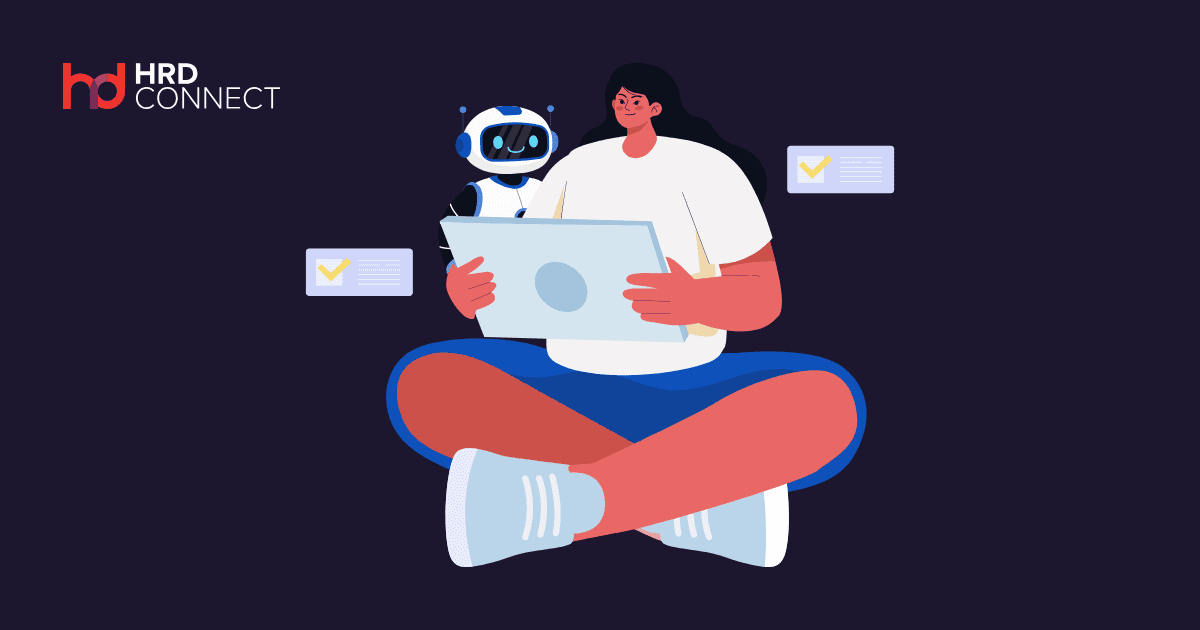
AI is often sold as a cure for burnout. Automate the repetitive work, speed up administration, reduce friction, free people for higher-value tasks. That promise is not entirely wrong. But in 2025 and 2026, the evidence is becoming more complicated.
Recent research suggests AI can reduce low-value workload in some contexts, while also intensifying pace, increasing multitasking and creating new forms of cognitive strain. In other words, the correlation between AI and burnout is real, but it is not linear. AI can relieve pressure, or it can amplify it, depending on how work is redesigned around it.
AI can remove friction, but it can also raise the bar
Many employees still see AI as potentially positive for productivity. PwC’s Global Workforce Hopes and Fears Survey 2025 found that workers’ optimism about AI’s potential outweighs anxiety overall, especially when it helps them work more effectively.
That optimism has a rational basis. AI can reduce time spent on drafting, summarising, searching, scheduling and other repetitive tasks. But the problem is what organisations do with the capacity that gets freed up. A growing body of evidence suggests that efficiency gains are often not returned to employees as breathing room. They are absorbed into higher output expectations instead.
Harvard Business Review reported in February 2026 that AI often does not reduce work so much as intensify it, particularly when organisations use the technology to accelerate task volume without redesigning priorities, workflows or accountability.
The real risk may be cognitive overload, not just longer hours
One of the most important findings emerging in 2026 is that AI may create a different type of burnout risk: mental fatigue caused by supervising, checking and coordinating with automated systems.
A 2026 study highlighted by Harvard Business Review and widely reported in the business press found that heavy AI use can produce what researchers describe as “AI brain fry” — a pattern of mental fog, slower decision-making and exhaustion linked to the cognitive load of managing multiple AI tools and validating their outputs. The effect was especially pronounced in functions such as HR, operations and marketing.
This matters because AI does not simply replace effort. In many roles, it shifts effort from doing the work to monitoring the work. That kind of vigilance can be mentally expensive, particularly when employees remain fully accountable for quality and outcomes.
AI may be accelerating the “infinite workday”
Microsoft’s 2025 Work Trend Index and its follow-up analysis on the “infinite workday” show that many employees are already operating in environments shaped by overload, fragmented attention and relentless digital activity. The research points to a workplace where interruptions are constant and focus is under pressure.
In that context, AI can become a multiplier. It can shorten cycle times, increase responsiveness expectations and make it easier for more work to flow toward the same people. The issue is not just that employees work faster. It is that faster work often becomes the new baseline.
A 2026 ActivTrak analysis, reported by major outlets, found that after AI adoption, task volume and multitasking rose while focused work fell. That is a warning sign for HR leaders, because burnout is not driven only by hours worked. It is also driven by fragmentation, decision fatigue and a lack of recovery time.
Burnout was already high before AI accelerated
This is why AI cannot be assessed in isolation. Gallup’s State of the Global Workplace 2025 found that employee wellbeing and engagement were already under strain, with managers in particular under significant pressure. Mental Health UK’s Burnout Report 2025 also pointed to persistent workplace stress and work-related mental health challenges, especially among younger workers.
AI is therefore landing in a workforce that was not exactly rested to begin with. That makes implementation design critical. Poorly introduced AI can become one more accelerant in an already overloaded system. Well-designed AI can reduce friction and restore capacity.
So what should HR do now?
The central issue is not whether AI is good or bad for burnout. It is whether the organisation is using AI to remove work or simply to intensify it.
HR leaders should ask three questions. First, where is AI genuinely removing low-value tasks, and where is it just adding oversight work? Second, are efficiency gains being reinvested in sustainable workload design, or converted into higher expectations? Third, do employees have the training, psychological safety and boundaries needed to work with AI without being overwhelmed? These questions are increasingly central to workforce design, not just technology deployment.
The organisations that get this right will treat AI as a capacity tool, not just a productivity engine. The ones that get it wrong may find that their AI strategy reduces admin on paper while increasing exhaustion in practice.