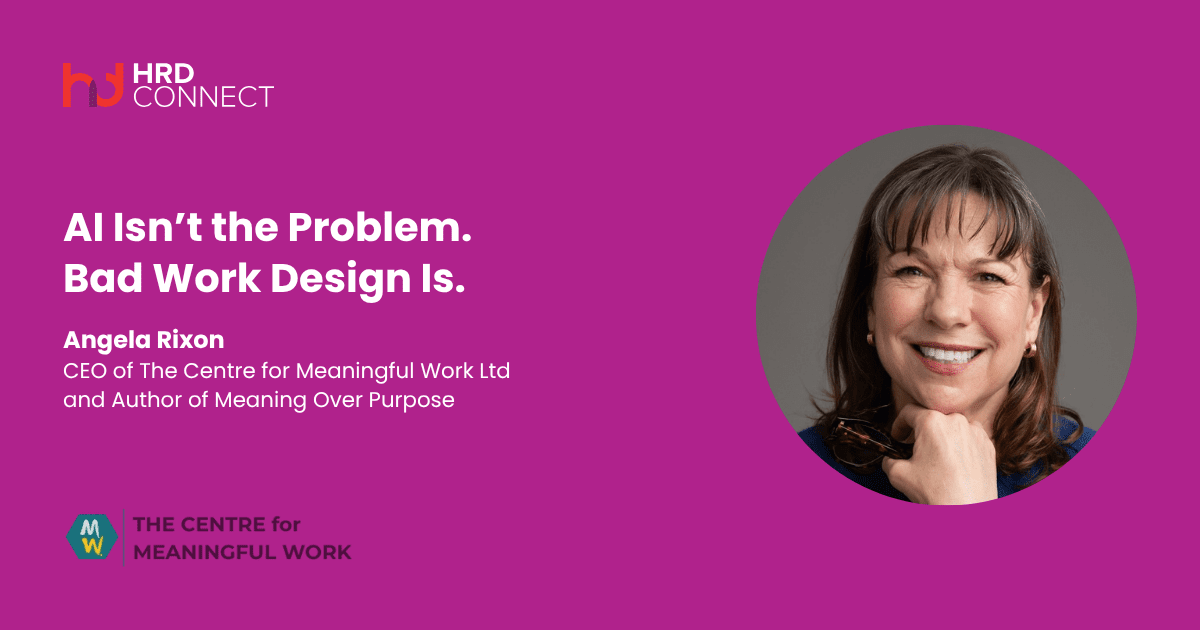
AI Isn’t the Problem. Bad Work Design Is.
- 4 Min Read
AI is helping employees work faster, but many organisations are failing to translate those productivity gains into meaningful business outcomes. Drawing on Gallup’s State of the Global Workplace 2026 report, Angela Rixon, CEO of The Centre for Meaningful Work and author of Meaning Over Purpose, argues that outdated work design, disengaged managers and ineffective operating models are the real barriers to AI success.
- Author: Angela Rixon
- Date published: Jun 25, 2026
- Categories
Companies keep asking why AI is not delivering the productivity gains they expected.
Most are asking the wrong question.
The problem is not whether employees can use AI. Many already are. The problem is whether organizations are built to turn individual productivity gains into business performance.
Many are not.
Gallup’s State of the Global Workplace: 2026 Report makes that harder to ignore. Global employee engagement fell to 20% in 2025, the first time engagement has dropped for two consecutive years in Gallup’s history. The bigger warning sign is who is driving that drop: managers. Since 2022, manager engagement has fallen from 31% to 22%.
At the same time, Gallup’s U.S.-based AI data shows a striking disconnect. In organizations that have implemented AI, 65% of employees say it has had a positive effect on their individual productivity. But only 12% strongly agree it has transformed how work gets done in their organization.
That is not a paradox. It is a diagnosis.
Companies are layering new technology onto old work design and wondering why the gains are not scaling.
The real bottleneck is managerial
AI can help people write faster, analyze faster, summarize faster, and automate routine work. But organizations do not run on isolated tasks. They run on priorities, handoffs, accountability, and judgment.
That is where the friction lives.
If AI helps employees move faster, but the surrounding system is still cluttered with unclear ownership, too many approvals, overloaded managers, and weak coordination, speed pushes more volume through a system that was already under strain.
Gallup’s data points directly to the missing lever. The top two drivers of frequent AI use are integration with existing systems and manager-led adoption. Employees who strongly agree that their manager actively supports their team’s use of AI are nearly 100 times more likely to strongly agree that AI has transformed how work gets done. Yet less than one-third strongly agree they are getting that kind of support.
In other words, companies are trying to scale AI through the least-supported layer of the business.
Stop treating engagement like a soft metric
One of the most expensive mistakes leaders make is treating engagement as HR data rather than operating data.
Engagement tells you whether people are willing to bring energy, initiative, and attention to the work in front of them. When it drops, change gets harder. Adoption slows. Performance weakens.
That matters even more when managers are under pressure. They are expected to deliver results, coach teams, maintain culture, manage hybrid work, and help people adopt AI responsibly. Yet their own engagement has dropped sharply.
We are asking managers to carry more at exactly the moment they have less capacity.
That is one reason AI gains are not turning into organizational gains.
The location debate still misses the point
For years, many companies have framed workplace strategy as a fight about office attendance.
Gallup’s findings suggest the deeper issue is not location alone. In 2025, job market optimism rose overall to 52%, but that increase came entirely from non-remote-capable, fully on-site workers. Optimism fell among fully remote workers and dropped sharply among remote-capable workers who are fully on-site.
That points to something more important than presence: choice.
Gallup’s broader analysis found that wellbeing and engagement improve when employees enjoy their work, believe it benefits others, and feel they have choices in what they do.
That is the real leadership challenge.
People do not disengage only because they are busy. They disengage when work feels controlled, fragmented, and stripped of meaning. AI does not solve that. If anything, it makes it more visible.
What smart leaders will do now
The best leaders will stop treating AI as a standalone technology initiative and start treating it as a work redesign challenge.
That means focusing on three questions:
- Where are productivity gains getting trapped before they become business value?
- Which managers are being asked to carry too much for AI adoption to succeed?
- Where does the organization reduce autonomy without improving performance?
Those are harder questions than “Which tool should we buy?” But they are the questions that matter.
The companies that pull ahead in the AI era will not simply automate more.
They will build organizations where managers are supported, work is coherent, and productivity gains can actually scale.
AI is not the core problem.
Bad work design is.
Angela Rixon is the CEO of The Centre for Meaningful Work Ltd and author of Meaning Over Purpose. She works with leaders, HR teams and change agents to embed meaningful work at scale through leadership, work design, culture and measurement.